Lith Corporation, founded in 1998 by a group of material science doctor from Tsinghua University, has now become the leading manufacturer of battery lab&production equipment. Lith Corporation have production factories in shenzhen and xiamen of China.This allows for the possibility of providing high quality and low-cost precision machines for lab&production equipment,including: roller press, film coater,mixer, high-temperature furnace, glove box,and complete set of equipment for research of rechargeable battery materials. Simple to operate, low cost and commitment to our customers is our priority.
Small Sputter Coater: Overview, Features, Process, Applications, Advantages, and Conclusion
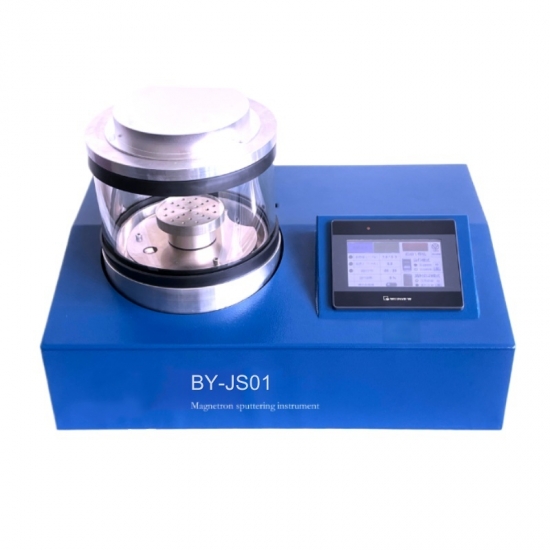
A Small Sputter Coater is a compact and efficient laboratory instrument designed for depositing thin, uniform, and adherent films onto a variety of substrates. Despite its reduced size, this equipment provides high-quality sputtering performance comparable to larger systems, making it ideal for research laboratories, educational institutions, and small-scale industrial operations. Small sputter coaters are widely used for preparing samples for scanning electron microscopy (SEM), atomic force microscopy (AFM), and other analytical instruments, as well as for thin-film applications in material science, electronics, and surface engineering.
Overview
The Small Sputter Coater functions using a vacuum-based physical vapor deposition (PVD) method. In this process, a target material, typically a metal or alloy, is bombarded by ions within a plasma environment, causing atoms to be ejected and deposited onto the substrate. This results in a thin, uniform coating with excellent adhesion. The compact design integrates essential components, such as a vacuum chamber, power supply, and automated control systems, into a small footprint while maintaining precise control over film thickness and uniformity.
This combination of performance and compactness makes the small sputter coater particularly suitable for laboratories with limited space, as well as for tasks that require quick and reliable sample preparation.
Key Features of Small Sputter Coaters
Modern Small Sputter Coaters are equipped with several key features:
High-Vacuum Chamber: Ensures high-purity deposition and reduces contamination.
DC or RF Sputtering Sources: Provides stable plasma generation for metals, alloys, and select insulating materials.
Automated Substrate Rotation: Guarantees uniform coatings on irregular or complex geometries.
Thickness Monitoring: Integrated sensors or quartz crystal microbalances (QCM) provide precise control over deposition rate and film thickness.
User-Friendly Interface: Simplified operation and pre-programmed cycles enable consistent and reproducible results.
Low Maintenance Design: Compact systems require minimal setup and maintenance, making them ideal for small labs or teaching purposes.
These features allow small sputter coaters to deliver professional-quality coatings with minimal operator training and operational complexity.
Small Sputter Coating Process
The coating process involves several steps:
Vacuum Preparation: The chamber is evacuated to a high vacuum to minimize contamination.
Plasma Generation: Argon or another inert gas is introduced, and DC or RF voltage generates a plasma.
Sputtering: Positive ions bombard the target material, ejecting atoms that deposit onto the substrate, forming a thin, adherent film.
Optional Reactive Mode: Introduction of gases such as oxygen or nitrogen can produce compound films like oxides or nitrides.
Layer Control: Film thickness is monitored and controlled using integrated sensors, ensuring precise deposition from a few nanometers to tens of nanometers.
The small sputter coater retains all essential sputtering functionalities while enabling efficient, fast, and reproducible sample coating.
Lab Sputter Coater
Applications
Small Sputter Coaters are versatile and widely applied in various fields:
Electron Microscopy: Coating non-conductive samples for SEM or AFM to prevent charging and enhance image quality.
Materials Research: Deposition of thin metallic or alloy films for surface studies, multilayer structures, and nanostructured materials.
Electronics and Sensors: Preparation of conductive layers for small electronic devices, MEMS, and sensors.
Surface Engineering: Production of corrosion-resistant, wear-resistant, or protective coatings on small parts and samples.
Educational and Training Labs: Compact design and ease of use make them ideal for teaching thin-film deposition and surface science principles.
Advantages
The main advantages of Small Sputter Coaters include:
Compact and Space-Saving: Suitable for laboratories with limited workspace.
High-Quality Coatings: Produces dense, uniform, and adherent films comparable to larger systems.
Versatility: Suitable for metals, alloys, and selected insulating materials.
Ease of Use: Pre-programmed cycles and automated controls reduce operator training requirements.
Rapid Sample Preparation: Short pump-down and coating cycles save time in research or teaching environments.
Reproducibility: Consistent film thickness and quality for multiple samples.
Conclusion
In conclusion, the Small Sputter Coater is an efficient, versatile, and compact tool for high-quality thin-film deposition. Its ability to deliver uniform, adherent, and precisely controlled coatings in a small footprint makes it ideal for research laboratories, educational settings, and small-scale industrial applications. By combining essential sputtering functionalities with ease of use, rapid operation, and reproducibility, small sputter coaters provide a reliable solution for SEM sample preparation, materials research, electronics fabrication, and advanced surface engineering.


 +86 13174506016
 Louis@lithmachine.com
 +86 18559646958
 18659217588
 English ▼


