Lith Corporation, founded in 1998 by a group of material science doctor from Tsinghua University, has now become the leading manufacturer of battery lab&production equipment. Lith Corporation have production factories in shenzhen and xiamen of China.This allows for the possibility of providing high quality and low-cost precision machines for lab&production equipment,including: roller press, film coater,mixer, high-temperature furnace, glove box,and complete set of equipment for research of rechargeable battery materials. Simple to operate, low cost and commitment to our customers is our priority.
Microwave Sintering Furnace: Innovative Technology for Rapid and Efficient Material Processing
Overview
A microwave sintering furnace is a cutting-edge thermal processing device that utilizes microwave energy to sinter metals, ceramics, and composite materials. Unlike conventional furnaces, which rely on conduction and convection for heating, microwave sintering furnaces directly couple electromagnetic energy into the material, resulting in rapid and uniform heating. This advanced technology enables shorter sintering times, energy-efficient operations, and enhanced material properties. It has become increasingly popular in research laboratories, advanced manufacturing, and high-performance material production.
Features
Modern microwave sintering furnaces are equipped with several advanced features designed to optimize performance and reliability:
Rapid Heating and Cooling: Microwave energy allows fast temperature ramps and precise control, reducing sintering cycles significantly compared to traditional furnaces.
Uniform Temperature Distribution: The furnace design ensures even microwave penetration and homogeneous heating, minimizing thermal gradients and reducing defects.
Programmable Temperature Profiles: Users can define precise heating rates, soaking times, and cooling rates to achieve tailored microstructures and material properties.
Controlled Atmosphere Capability: Many microwave sintering furnaces can operate under inert, reducing, or custom gas atmospheres to prevent oxidation and enable specialized material processing.
Compact and Efficient Design: Microwave sintering furnaces are generally smaller and more energy-efficient than conventional high-temperature furnaces, making them suitable for lab-scale and pilot production.
Sintering Process
The microwave sintering process involves several key stages:
Material Loading: Powders, green compacts, or preformed parts are placed inside the microwave cavity. Proper placement ensures uniform microwave exposure.
Microwave Heating: Electromagnetic waves penetrate the material, causing volumetric heating. Unlike conventional furnaces, heat is generated internally, leading to faster and more uniform sintering.
Soaking/Consolidation: Materials are held at the target temperature to facilitate particle bonding, densification, and microstructural development. Controlled atmosphere ensures chemical integrity and prevents oxidation.
Controlled Cooling: The furnace cools materials at a programmed rate to avoid thermal stresses and preserve the desired microstructure. Some systems allow continued atmospheric control during cooling.
Post-Sintering Handling: Once the process is complete, components are removed and can undergo additional processing or direct application.
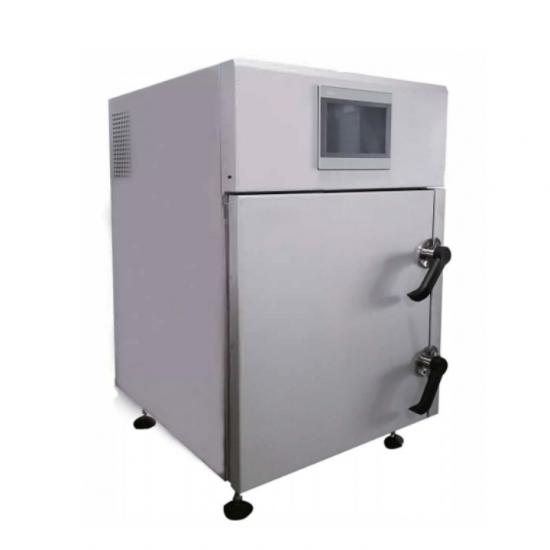
Microwave Furnace
Applications
Microwave sintering furnaces are highly versatile and widely used across industries where precise material properties are critical:
Ceramic Fabrication: Sintering of advanced ceramics such as alumina, zirconia, and silicon carbide for electronics, biomedical devices, and structural applications.
Metal Powder Processing: Rapid sintering of stainless steel, titanium, and other metal powders used in aerospace, automotive, and tooling industries.
Composites and Nanomaterials: Processing of ceramic-metal composites and nanostructured powders requiring uniform microstructures.
Research and Development: Lab-scale microwave furnaces are ideal for experimental material synthesis, optimization, and pilot-scale production.
Energy Devices: Sintering of solid oxide fuel cell (SOFC) components, battery electrodes, and other energy storage materials for enhanced performance.
Advantages
The microwave sintering furnace offers several notable advantages over conventional sintering technologies:
Faster Processing: Microwave heating dramatically reduces sintering time, enabling higher throughput and efficiency.
Energy Efficiency: Direct volumetric heating minimizes energy loss, lowering operational costs.
Improved Material Properties: Uniform heating and controlled atmospheres lead to higher density, improved mechanical strength, and superior electrical or thermal conductivity.
Reduced Defects: Even heating and precise temperature control reduce warping, cracking, and internal stresses, enhancing product reliability.
Compact and Flexible: Smaller furnace footprint and adaptable configurations make microwave sintering furnaces suitable for labs, pilot plants, and specialized production lines.
Conclusion
A microwave sintering furnace represents a significant advancement in material processing technology. By combining rapid volumetric heating, precise temperature control, and atmosphere management, these furnaces enable superior material quality, reduced processing time, and energy-efficient operations. From advanced ceramics and metal powders to fuel cells and composite materials, microwave sintering furnaces are indispensable tools in modern industrial manufacturing and scientific research, offering unmatched performance and versatility.


 +86 13174506016
 Louis@lithmachine.com
 +86 18559646958
 18659217588
 English ▼


